
India’s Maritime Connectivity Can Shape Its Strategic Future

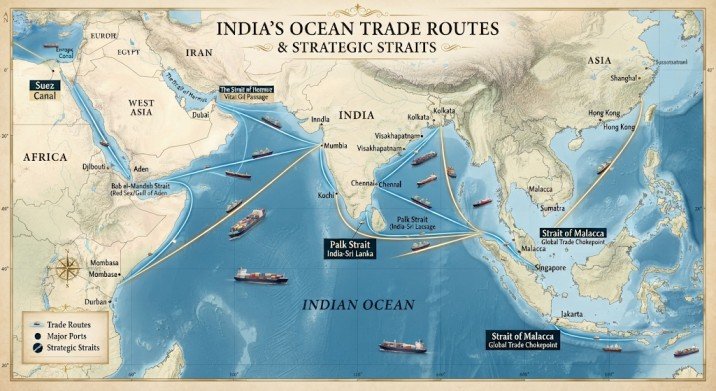
Infrastructure, connectivity and transportation have acquired new geopolitical significance in the twenty-first century. Beyond facilitating trade, ports, maritime routes and transport corridors have become instruments of economic influence and national security. According to UNCTAD’s Review of Maritime Transport 2024, over 80 per cent of global trade by volume is carried by sea, underscoring the strategic importance of maritime routes and chokepoints.
This growing significance has intensified competition among major powers to shape global connectivity networks. China’s Belt and Road Initiative (BRI) has expanded Beijing’s economic and geopolitical influence across Asia, Africa and Europe. Research by the US Federal Reserve estimates that BRI-related transport projects could reduce aggregate global trade costs by approximately 1.1–2.2 per cent. However, concerns surrounding debt sustainability and strategic dependence have accompanied China’s infrastructure expansion. In response, initiatives such as India’s proposed India–Middle East–Europe Economic Corridor (IMEC), launched through a memorandum of understanding in September 2023, and the International North–South Transport Corridor (INSTC) reflect efforts to diversify global trade networks.
For India, connectivity is closely linked to its pursuit of strategic autonomy. Traditionally rooted in non-alignment, this principle has evolved to encompass economic security, diversified supply chains, maritime stability and freedom of foreign policy choices. India’s geographical position at the intersection of the Indian Ocean, the Bay of Bengal and the Arabian Sea provides considerable strategic advantages. However, geography alone cannot translate into geopolitical influence without effective infrastructure, institutional cooperation and sustained investment.
India’s connectivity initiatives address different strategic vulnerabilities. Chabahar Port in Iran and the INSTC aim to improve India’s access to Afghanistan, Central Asia, Russia and markets beyond, while reducing dependence on transit routes through Pakistan. According to the Ministry of External Affairs, Chabahar has handled cargo from multiple countries since becoming operational in December 2018. The INSTC, meanwhile, offers a multimodal network connecting India with Iran, Russia and Central Asia, potentially reducing transportation time and costs.
IMEC seeks to strengthen India’s connectivity with West Asia and Europe through an integrated network of shipping and rail links. Unlike the INSTC, which primarily connects India with Eurasian markets, IMEC offers an alternative pathway towards European markets and deeper economic partnerships with Gulf countries. Both corridors can expand India’s strategic options, although their effectiveness depends on regional stability, investment commitments and the development of supporting infrastructure.
While these initiatives strengthen external connectivity, domestic infrastructure remains equally important. The Sagarmala Programme seeks to modernise ports, improve port connectivity and reduce logistics costs. As of 24 March 2026, 315 Sagarmala projects had been completed, with 210 under implementation and 320 in the planning stage. This demonstrates the scale of India’s maritime infrastructure ambitions. External corridors can deliver meaningful economic benefits only when domestic ports, railways and road networks can efficiently facilitate the movement of goods.
The Andaman and Nicobar Islands add a distinct security dimension to India’s connectivity strategy. Their proximity to the Strait of Malacca, through which approximately 22.5 million barrels per day of petroleum liquids passed in 2024, gives India considerable strategic relevance in the Indo-Pacific. Strengthening maritime surveillance, infrastructure and operational capabilities in the islands can improve India’s ability to protect vital sea lanes and contribute to regional maritime security.
These infrastructure initiatives are complemented by India’s broader maritime engagement through SAGAR (Security and Growth for All in the Region), the Indo-Pacific Oceans Initiative and the Indian Ocean Rim Association. Together, they reflect an approach that combines economic connectivity with maritime cooperation and regional diplomacy.
Nevertheless, India’s ambitions face considerable implementation challenges. Instability in West Asia threatens the progress of IMEC, while international sanctions on Iran complicate investments and operations involving Chabahar and the INSTC. Competition from China’s BRI further increases the strategic complexity. Domestically, land acquisition, environmental clearances, funding constraints, bureaucratic delays and inadequate coordination between agencies can undermine project execution.
India must therefore move beyond announcing ambitious corridors towards ensuring their operational viability. Priorities should include mobilising sustainable public and private investment, strengthening multimodal connectivity, improving inter-agency coordination and establishing reliable partnerships with transit countries. Diversifying routes must also involve assessing their commercial viability rather than treating every infrastructure project as an instrument of geopolitical competition.
Ultimately, India’s strategic autonomy will depend not merely on the number of ports or corridors it develops, but on its ability to convert connectivity into reliable economic alternatives and strategic leverage. By integrating domestic infrastructure development with diversified international partnerships and maritime security, India can strengthen its position in an increasingly competitive global order while preserving its freedom of strategic choice.
Continue reading
The Geoeconomics of India–EU Defence Cooperation
India and the EU seek to move beyond defence procurement towards technology-sharing, joint manufacturing and resilient supply chains. The challenge lies in…

India Must Attach Reciprocal Conditions to Nuclear Finance
Opening a new source of capital requires a clearer account of construction risk and public responsibility. Without reciprocal mechanisms, nuclear finance becomes…


The Human Cost of Maritime Insecurity: India’s Missing Policy Link
When a commercial vessel is attacked in contested waters, the consequences rarely remain at sea. They extend to energy markets, industrial supply…

Minakshi Sharma
Minakshi Sharma is Outreach and Strategic Communications Intern at IndiaForth