
The Geoeconomics of India–EU Defence Cooperation

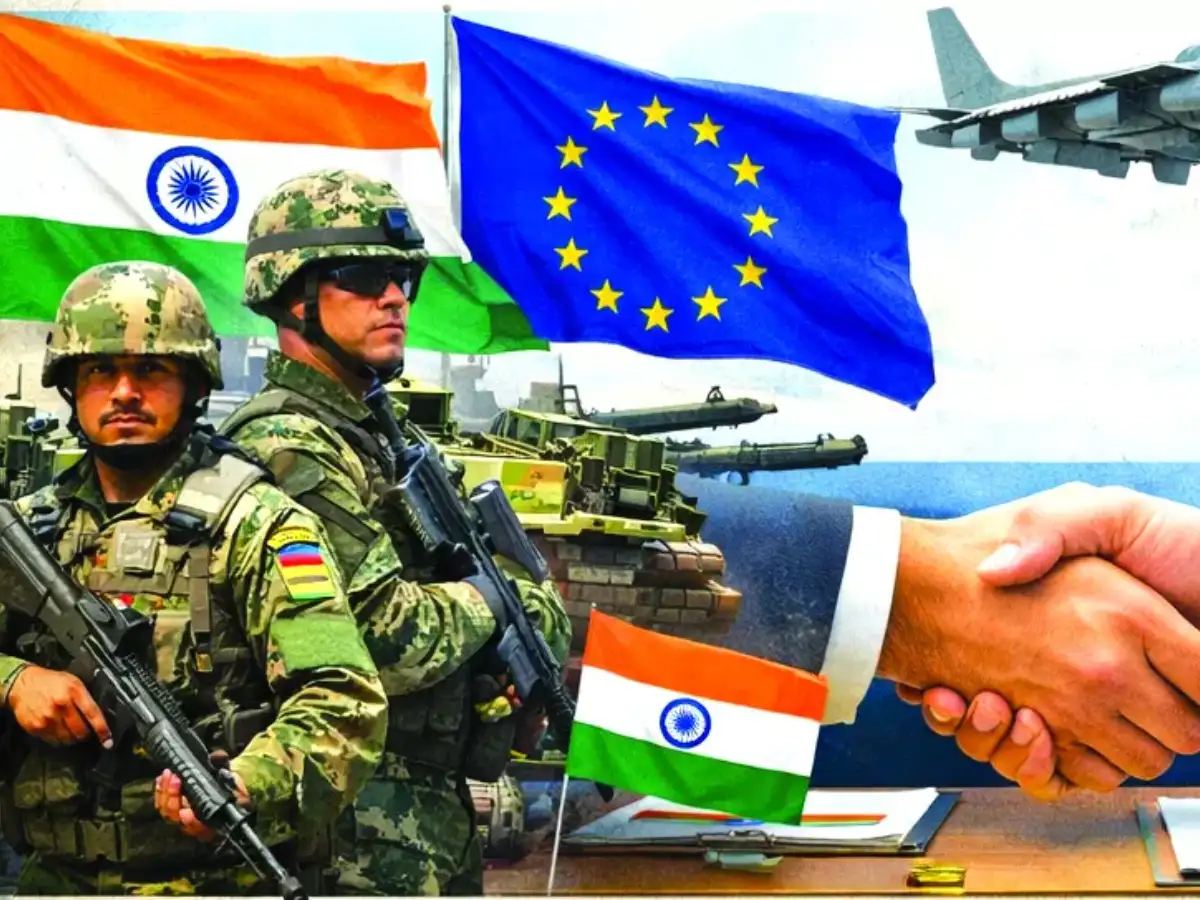
India and the EU seek to move beyond defence procurement towards technology-sharing, joint manufacturing and resilient supply chains. The challenge lies in converting strategic commitments into tangible industrial outcomes.
By Sudeepthi Munagala
India and the European Union (EU) have taken an important step towards strengthening their security and defence relationship. On 27 January 2026, both sides signed a Security and Defence Partnership at the 16th India–EU Summit in New Delhi. The agreement reflects a growing recognition that economic security, technological capabilities and geopolitical stability are increasingly interconnected. However, its real significance will depend on whether diplomatic commitments translate into practical industrial and technological cooperation.
India and Europe have different security priorities, even where their interests overlap. For India, security concerns centre on its unresolved border tensions with China, instability in its neighbourhood and the protection of critical sea lanes in the Indian Ocean. Europe, meanwhile, faces an increasingly uncertain security environment following Russia’s war against Ukraine and questions surrounding the long-term reliability of transatlantic security arrangements. These differences make strategic cooperation necessary, but they also place limits on how far both sides can align their defence policies.
The January partnership provides an institutional framework to address these challenges. It identifies areas of cooperation including maritime security, cybersecurity, counterterrorism, space security, artificial intelligence, emerging technologies and the protection of critical infrastructure. This builds on existing engagement, including India’s participation in counter-piracy activities with the European Union Naval Force (EUNAVFOR) in June 2025. The first EU–India Security and Defence Dialogue, held in New Delhi on 6 March 2026, further demonstrated the intention to move towards structured cooperation. However, regular dialogue alone cannot guarantee operational coordination or shared strategic outcomes.
The economic dimension of this partnership deserves particular attention. Defence cooperation is no longer limited to purchasing military equipment. It increasingly involves control over technology, intellectual property, critical components, production capacity and supply chains. For India, this creates an opportunity to engage European defence industries not merely as a buyer but as a manufacturing and technology partner.
India has already made progress in strengthening its domestic defence manufacturing base. According to the Ministry of Defence, domestic defence production reached ₹1.78 lakh crore in FY 2025–26, while defence exports reached ₹38,424 crore. These figures indicate an expanding industrial base, but higher production does not automatically translate into technological independence. Access to advanced components, specialised technologies, research capabilities and intellectual property remains important for building a more self-reliant defence ecosystem.
European cooperation could help address some of these gaps. European countries possess established capabilities in aerospace, naval systems, electronics, advanced materials and defence technologies. Collaboration in research and development, component manufacturing, maintenance, repair and overhaul, and joint production could create opportunities for both sides. Such arrangements would also allow European companies to access India’s growing manufacturing base and industrial market.
However, the European side has its own constraints. The EU is not a single, centralised defence procurement market. Member states retain significant control over their defence spending, procurement decisions and export policies. Differences in national regulations, technology-transfer restrictions and security requirements can complicate industrial partnerships. Therefore, an agreement signed at the EU level will still require cooperation with individual European governments and companies to deliver tangible outcomes.
The conclusion of negotiations on the India–EU Free Trade Agreement on 27 January 2026 adds another economic dimension to this relationship. Although the FTA and the Security and Defence Partnership are separate agreements, together they create a broader framework for trade, investment and industrial cooperation. Their potential connection lies in strengthening supply chains, improving market access and encouraging investment in strategic sectors. The FTA must, however, complete the necessary legal and internal approval procedures before it becomes binding.
For India, the objective should not be to replace one external defence dependency with another. Greater engagement with Europe must complement domestic research, manufacturing and technological development. This requires clear provisions for technology transfer, Indian participation in research projects, local manufacturing, protection of intellectual property and opportunities for domestic private-sector suppliers. Cooperation should also prioritise areas where both sides have identifiable interests rather than assume complete geopolitical alignment.
Ultimately, the India–EU Security and Defence Partnership offers an opportunity to expand the relationship beyond traditional diplomacy and arms procurement. Its success will depend on whether both sides can convert shared security concerns into commercially viable, technologically meaningful and sustainable industrial partnerships. The real measure of strategic cooperation will not be how many agreements India and Europe sign, but how much technological capability, industrial capacity and strategic resilience they build together.
Continue reading
India Must Attach Reciprocal Conditions to Nuclear Finance
Opening a new source of capital requires a clearer account of construction risk and public responsibility. Without reciprocal mechanisms, nuclear finance becomes…


The Human Cost of Maritime Insecurity: India’s Missing Policy Link
When a commercial vessel is attacked in contested waters, the consequences rarely remain at sea. They extend to energy markets, industrial supply…

India’s Maritime Connectivity Can Shape Its Strategic Future
Infrastructure, connectivity and transportation have acquired new geopolitical significance in the twenty-first century. Beyond facilitating trade, ports, maritime routes and transport corridors…

Sudeepthi Munagala
Sudeepthi Munagala is Honorary Research Associate at India Forth. She has completed MSc Global Governance and Ethics graduate from University College London (UCL). Her research interests include geopolitics, international relations, public policy, global governance, and India–Europe relations.